Poshanu Towers Phan Thiet – Complete Guide, History & Travel Tips
Amid the beaches and resorts of Phan Thiết and Mũi Né, there is a place that does not compete for attention—yet leaves a lasting impression on those who slow down long enough to notice. That place is Po Sah Inu tower, often referred to as the Poshanu Towers.
This is not just another tourist stop. It is a preserved layer of the ancient Cham Pa civilization—expressed through architecture, religion, and living cultural traditions that still resonate today.
From the perspective of PhanThietchill, this guide combines historical research, on-site observations, and practical travel insights to answer three essential questions:
- What makes Poshanu Towers special?
- Is it worth visiting?
- How should you experience it to truly appreciate its value?
If you are looking for a destination that offers more than surface-level beauty, this is where your journey begins.


Overview of Poshanu Towers
Tháp Pô Sah Inư is a relatively small complex of Cham towers, but its cultural and historical significance is far greater than its size suggests.
Quick Facts
- Location: Ba Nai Hill, Phu Thuy Ward.
- Distance:
- ~7 km from Phan Thiet center
- ~11 km from Mui Ne Market
- Part of: Lầu Ông Hoàng historical complex
- Construction period: Late 8th – early 9th century
- Religion: Hinduism
Unlike larger and more famous sites such as My Son, Poshanu feels more intimate. It does not overwhelm you with scale. Instead, it invites you to observe, reflect, and connect.
“Not every destination is meant to impress at first glance—some places, like Poshanu Towers, are meant to be felt over time.”
Historical Background and Cultural Significance
The Cham Pa Legacy
The towers were originally built to worship Shiva, one of the most important deities in Hinduism.
This reflects two key aspects:
- The strong influence of Indian religion on Cham culture
- The central role of spirituality in the daily life of the Cham people
Even today, local Cham communities continue to visit and maintain the site, preserving its living cultural relevance.
The Story of Princess Poshanu
By the 15th century, the site evolved to include the worship of Princess Poshanu.
According to oral traditions:
- She taught people wet rice cultivation
- Promoted textile weaving
- Guided daily agricultural practices
This transforms the site from a purely religious monument into something more human—a place that honors both divine belief and community memory.
Restoration and Preservation
- Archaeological excavations: 1992–1995
- Restoration period: 1990–2000
Today, the towers are relatively well preserved, though natural weathering is visible. This balance between restoration and authenticity adds to the site’s credibility and historical integrity.

Architecture – The Essence of Hòa Lai Style
Overall Design
The towers follow the Hoa Lai architectural style, one of the earliest and most refined Cham styles.
Key characteristics:
- Tightly fitted baked bricks without visible mortar
- Strong geometric forms
- Minimal but precise decorative elements
It is not extravagant—but structurally sophisticated and artistically intentional.
Main Tower (Tower A)
The central structure is the most complete and important.
- Height: ~15 meters
- Structure: 4 tiers, gradually narrowing upward
- Orientation: East-facing (sacred direction in Cham belief)
Inside, you will find the sacred Linga Yoni, representing creation and cosmic energy.
Notable features:
- Natural ventilation system
- Subtle yet intricate carvings
This tower alone tells a complete story of Cham religious architecture.
Secondary Towers (B and C)
- Tower B: ~12 meters, simpler structure
- Tower C: partially ruined
Although less intact, they help reconstruct the original layout and scale of the complex.
Real Experience – What It Feels Like to Visit
Here is the honest part.
Poshanu is not a place that impresses instantly.
It does not deliver the typical “wow” moment.
But if you stay a little longer, something shifts.
Atmosphere
- Located on a hill
- Constant sea breeze
- Quiet and uncrowded
The feeling is:
- Calm
- Reflective
- Undisturbed by heavy tourism
What You Can Do
- Enjoy panoramic views of the Phan Thiet coastline
- Photograph ancient architecture
- Observe the local Cham cultural presence
This is not a “quick check-in” destination. It is a place for slow travel.
Festivals at Poshanu Towers
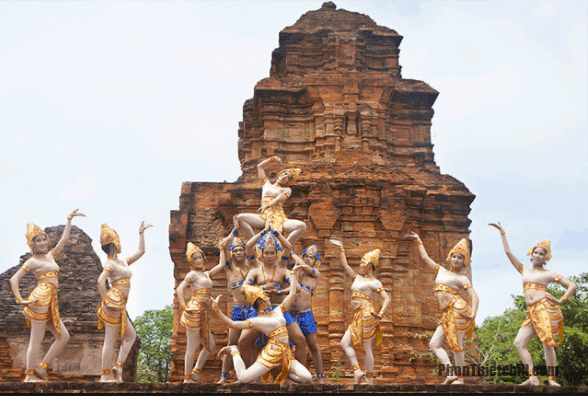
Kate festival
The most important Cham festival:
- Time: September–October (Gregorian calendar)
- Activities:
- Traditional dances
- Cham musical instruments
- Religious rituals
The atmosphere is vibrant but still deeply spiritual.
Rija Nuga Festival
- Held early in the year
- Focus: prayers for rain and prosperity
Less tourist-oriented, more authentic in ritual meaning.
Comparison with Other Cham Sites
| Criteria | Poshanu | My Son Sanctuary |
|---|---|---|
| Scale | Small | Large |
| Popularity | Moderate | High |
| Atmosphere | Quiet | Touristy |
| Preservation | Good | Partially damaged |
👉 Poshanu is ideal if you prefer a peaceful, less crowded experience.
Pros and Cons (Honest Review)
Advantages
- Strong historical authenticity
- Easy access
- Less crowded
- Scenic hilltop views
Limitations
- Small scale
- Short visit time (30–60 minutes)
- Limited activities outside festival periods
Travel Tips
Best Time to Visit
- Early morning or late afternoon
- Avoid midday heat
What to Bring
- Hat and water
- Comfortable shoes
Etiquette
- Do not climb structures
- Do not touch artifacts
- Keep noise levels low
Nearby Attractions
You can combine your visit with:
- Ong Hoang Hill
- Ong Dia rock beach
- Mui Ne sand dunes
Perfect for a half-day itinerary.

Is Poshanu Towers Worth Visiting?
The answer is not simply yes or no.
It depends on your expectations.
Poshanu is NOT for:
- Fast-paced travelers
- People looking for luxury or entertainment
But it IS for:
- Cultural explorers
- Slow travelers
- Those who appreciate history and silence
FAQ
Where are Poshanu Towers located?
They are located on Ba Nai Hill, about 7 km from Phan Thiet center, and about 11km from Mui Ne market
How long does a visit take?
Around 30–60 minutes.
Is it worth visiting?
Yes, especially if you are interested in culture and history.
When is the best time to visit?
Early morning or late afternoon.
Are there festivals?
Yes, the Katê Festival is the most important annual event.
Final Thoughts (PhanThietchill Perspective)
Po Sah Inu tower is not the most spectacular landmark in Vietnam.
But it is one of the most meaningful—if you approach it the right way.
In travel, the most memorable places are not always the most famous.
Sometimes, they are simply the ones that make you feel something real.